Like many people who've visited their tower manufacturer's website, I came away with the belief that the pricing of their motor drives was a bit over the top, so I avoided buying one. Being a long-term cubical quad owner means occasional broken wires, not to mention the fact that here in Florida we see squalls move in quickly from the Gulf, necessitating the need to lower the tower in short order. It can get old fast!
I looked at some possible solutions that might involve both electric hoists and winches to raise and lower my tower. I quickly found out that there is a difference between a hoist and a winch. Here's a couple of explanations that I found on the web that will help to clarify:
With all of that said, the primary objective is to raise and lower a heavy load in a controlled manner and hold it in place for extended periods of time. A hoist was obviously in order.
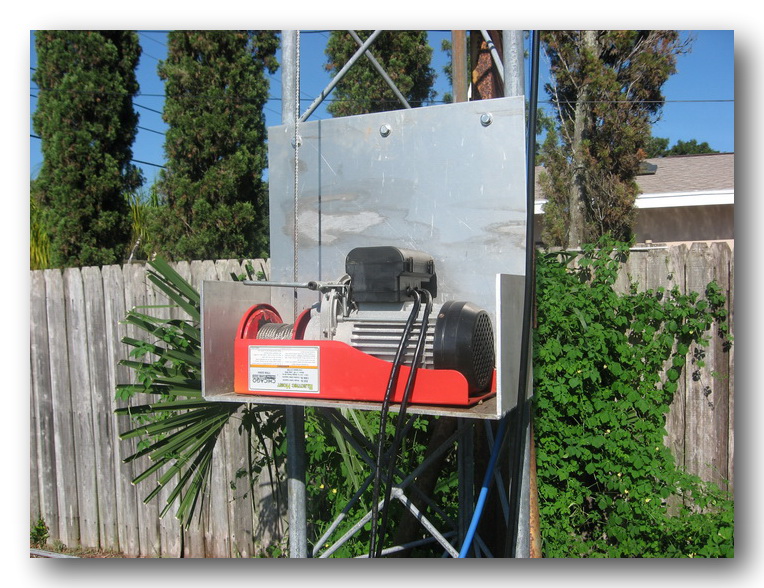
I did some searching on the web for hoists and came up with two distinct categories: engine hoists and boat hoists. Within the boat hoist category, there's a further distinction and that's closed vs. open type drive. The open drive being the most common type, but we'll touch on them both. In looking over the differences between the engine and the boat hoists, what was most obvious to me was that the engine hoist - once mounted in an inverted fashion didn't need anything else to make it work other than an attachment point. I had a welder fashion an aluminum plate/tray to which the engine hoist is mounted to. I then bolted the mated pair to the existing tower mounting plate where the original hand crank was mounted and simply routed the existing tower lifting cable onto the engine hoist's drum and I was ready to go!
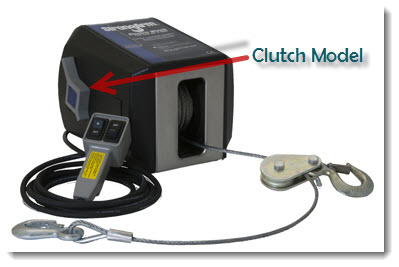
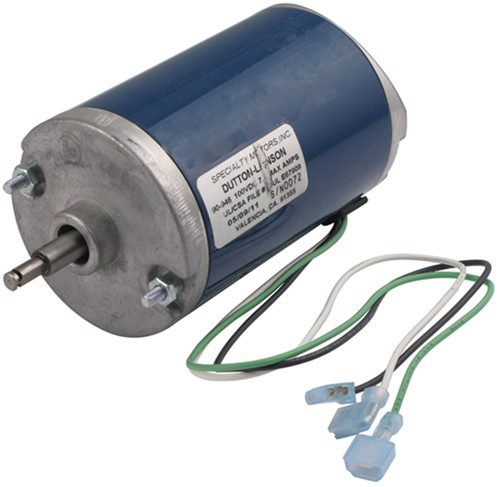
Why not use the larger, more durable boat hoist? The typical boat hoist is only half of the equation. It lacks the take-up drum. Take a look at the pictures below and you'll notice that the engine hoist is a self contained, ready to go unit. Motor, housing & take-up drum are all there. All you have to do is mount the hoist in an inverted fashion to something. With 650 lbs. of single line hoisting power it's enough to lift two TX-455 tower sections at under 350 lbs plus some room for antennas and a mast. Headroom - probably not enough for some.
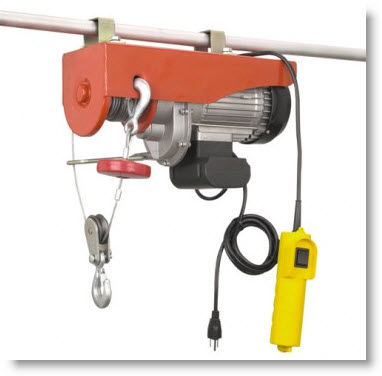
2000 lb. (dual line) - 1000 lb (single line) Industrial Heavy-Duty Hoist from Northern Tool
The Harbor Freight Tools 1300# Engine Hoist in use on my US Tower TX-455
Note how clean it is. It is kept that way under a canvas cover with a slit cut in it to
accommodate the cable from above. It was built for inside use.
The typical Flat Plate Boat Hoist is available, rated anywhere from 3000 lbs. to 8500 lbs.
and lacks only a mount, adapter sleeve and drum for tower use. Looking at the specs for the smaller units (4000 lb. class) they have a travel speed of about 3 ft. per minute. You'll sometimes see these advertised as 'open' units because the wormgear is exposed. These units are usually covered in their entirety with a white plastic weather shield.
Adapter sleeve connects the flat plate hoist's large gear to the drum.
Some examples of take-up drums.
The upper picture depicts a drum with cable winder grooves.
Now that we see what the major components look like that are required to place a flat plate hoist into operation we only need to adapt the assembled pieces into something that will do the required work while attached to the tower.
Attaching any one of the drums pictured above to the face of the tower shouldn't be a problem as there is already a mounting surface for the original Fulton K1550 hand operated winch and brake set.
The difference between a winch and a hoist:
So many customers have asked this question, so we thought we would post it for your convenience.
What is the difference between and WINCH and a HOIST?
A Winch is for pulling, a Hoist is for Lifting.
You could probably push or move your car, but you could never dead lift it. A Hoist is geared differently and has locking brakes to hold a load.
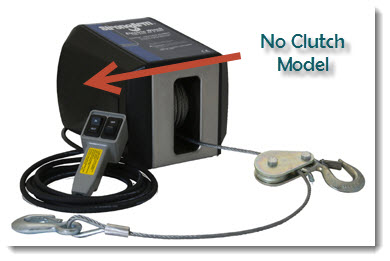
A Winch is for pulling a load, most of the time has dynamic brakes, but can slide.
If a Hoist can lift 250 lbs, it can likely pull 1000 lbs.
If a winch can pull 1000 lbs in can probably only lift 100 lbs.
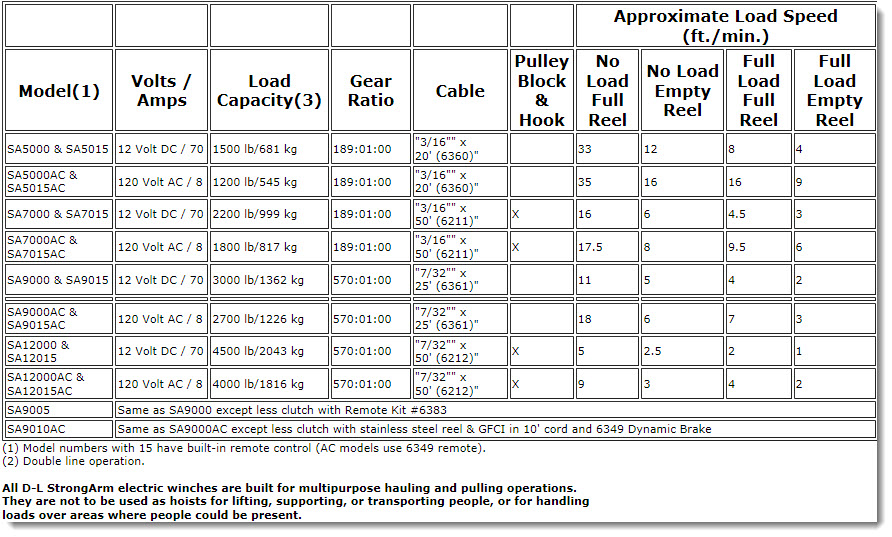
Some winches have a "Lifting" and a "Pulling" capacity ratings. These winch/hoist products are made to your specs when you order them and designed to do duel industrial jobs.
That is why on some of our other winches you see two different sets of specs. One for the lifting capacity, and another for the pulling capacity of the product.